Conventional Septic System Installation
Professional septic tank and drain field installation services for residential and commercial properties across your local area – request a free consultation and estimate from our experienced staff today
Licensed & Insured
NOWRA certified technicians on every job
24/7 Emergency Service
Available whenever you need us most
Nationwide Coverage
Serving all 50 states across the USA
Transparent Pricing
Flat rates with no hidden fees
Get Immediate Service
Speak directly with our team – no automated systems
24 Hours – 7 Days a Week
5 Highlights on Conventional Septic System Installation
Full Site Assessment and Perc Testing
Our certified soil scientists evaluate your property’s permeability, infiltration rate, and water table depth before we design a single trench. Every conventional septic system installation starts with accurate percolation test data and soil classification to determine the appropriate system type so your drain field absorbs and treats wastewater correctly from day one. We give you clear information about soil conditions and help you find the best design for your lot.
Permitted and Code Compliant Work
Action Septic Service secures all required health department permits, files as built drawings, and schedules inspections at every phase. Your gravity fed septic system meets or exceeds local sanitary code regulations, and our team takes action to ensure full compliance with inspection requirements.
Engineered for Your Lot
We handle proper sizing of your septic tank, distribution box, and lateral lines based on actual hydraulic load calculations, house bedroom count, and daily water usage volume. No guesswork. No undersized components.
Quality Precast Concrete and Polyethylene Components
We install reinforced, watertight precast concrete and fiberglass septic tanks with factory installed baffles, inlet tees, outlet tees, and effluent filters. Every component we bury is designed for long lasting life expectancy and built to last decades underground.
Defined Reserve Area Protection
Each installation includes a mapped replacement area so your property retains a viable location for a future drain field replacement if the primary absorption field ever needs retirement. This ensures you have options for future maintenance and system longevity.
Need Immediate Septic Service?
Our team is standing by to help – same week appointments available.
Why Choose Our Conventional Septic System Installation
Conventional septic system installation is the core of what Action Septic Service does – it is our business and our expertise. We’ve built our reputation on precise excavation, correct pipe grades, and septic tanks that settle into their beds without shifting. Our installers are licensed, insured, trained, and certified through state and county health departments. That matters when your property’s wastewater treatment depends on getting the slope, aggregate depth, and trench spacing right the first time. With decades of combined experience, our team knows how to handle every type of installation.
We don’t subcontract the critical work. Our own crews operate the backhoes and excavating equipment, compact the backfill material, and connect every PVC lateral line. One team owns the project from the initial soil survey through the final grading and topsoil cover. You get a single point of contact who knows your site plan, your setback requirements, and your permit conditions. Our staff and owner maintain hands-on control of every job from start to finish.
Action Septic Service guarantees the structural integrity of every septic tank, distribution box, and drain field we install. If a component we placed fails within our warranty period, we repair or replace it at no additional cost. We also provide a complete as built drawing package with all the details so you, your engineer, and your local health department inspector all have accurate records of tank location, pipe routing, and reserve area boundaries. Rest assured your system will function properly for years to come.
Our pricing is transparent. We quote conventional septic system installation as a fixed project cost – no hidden fees, no surprise charges, and no extra costs for gravel delivery, geotextile fabric, or permit fees. You approve the estimate before we break ground, and we deliver outstanding value on every job.
States Served Nationwide
Emergency Availability
Licensed & Insured
Hidden Fees – Ever
Signs You Need Conventional Septic System Installation
Conventional septic system installation becomes necessary under specific, recognizable conditions. Here are five situations that help you identify when a new gravity fed system is required on your property. If you find yourself dealing with any of these situations, please call us for help.
You're Building on an Undeveloped Lot:
New residential house construction on a property without municipal sewer access requires an onsite wastewater system. If your soil has adequate permeability and your water table sits deep enough below the proposed trench elevation, a conventional septic tank and absorption field is the most cost effective and reliable solution. Your building permit won’t close without a permitted septic installation. This applies to both rural lots and unincorporated areas where you need to build and set up your own wastewater system.
Your Existing Cesspool or Cesspit Is Failing:
Older properties sometimes rely on old cesspools that predate modern sanitary codes. When a cesspool collapses, overflows, or contaminates nearby groundwater with coliform bacteria and nitrates, the health department will require you to decommission it and install a compliant conventional septic system that meets current regulations. Many homeowners have found their cesspool cannot be made clean or safe enough to satisfy modern requirements.
Sewage Is Backing Up Into Your Home:
Persistent blackwater backups through floor drains or toilet lines can indicate a failed drain field where the biomat has clogged the soil’s absorptive layer beyond recovery. When a septic inspector confirms the leach field can no longer percolate effluent, a full replacement installation is the fix. No amount of plumbing repairs or cleaning will resolve this type of failure.
Your Perc Test Results Support a Conventional Design:
Some properties qualify for a standard gravity fed system rather than a more expensive mound system or aerobic treatment unit. If your soil scientist confirms loam or sandy loam with acceptable infiltration rates in the right soil class, you can save thousands by going conventional. From our view, this is the better choice when site conditions allow.
You're Converting a Holding Tank Property:
Properties running on holding tanks require frequent pump truck visits to empty hundreds or thousands of gallons. Installing a conventional septic system with a properly sized drain field eliminates recurring pumping and hauling costs and gives you a permanent, decentralized wastewater treatment solution. We offer this service to serve homeowners who are tired of constant tank maintenance.
Licensed & Bonded
Full compliance in all 50 states
Detailed Reports
Complete documentation every visit
Flat Rate Pricing
No hidden fees or surprises
Fast Scheduling
Same week appointments available
Our Conventional Septic System Installation Process
Conventional septic system installation follows a defined sequence. Each step builds on the last, and we don’t advance until the previous phase passes inspection. We follow this process carefully on every job to ensure quality results.
Site Evaluation and Soil Testing
We survey your lot, stake proposed component locations, and conduct percolation tests. Our soil scientist classifies the soil profile – clay content, silt layers, sand composition, and depth to bedrock, hardpan, cobble, or saturated zones. We dig test pits vertically to view soil layers and determine absorption rate.
System Design and Permitting
Using perc test data and hydraulic load calculations, we design the septic tank size, drain field dimensions, trench depth, and pipe layout. Our general engineering contractor submits the site plan, elevation drawings, and engineering specs to your local health department for permit approval. We schedule an appointment to review the design with you before submission.
Excavation and Tank Placement
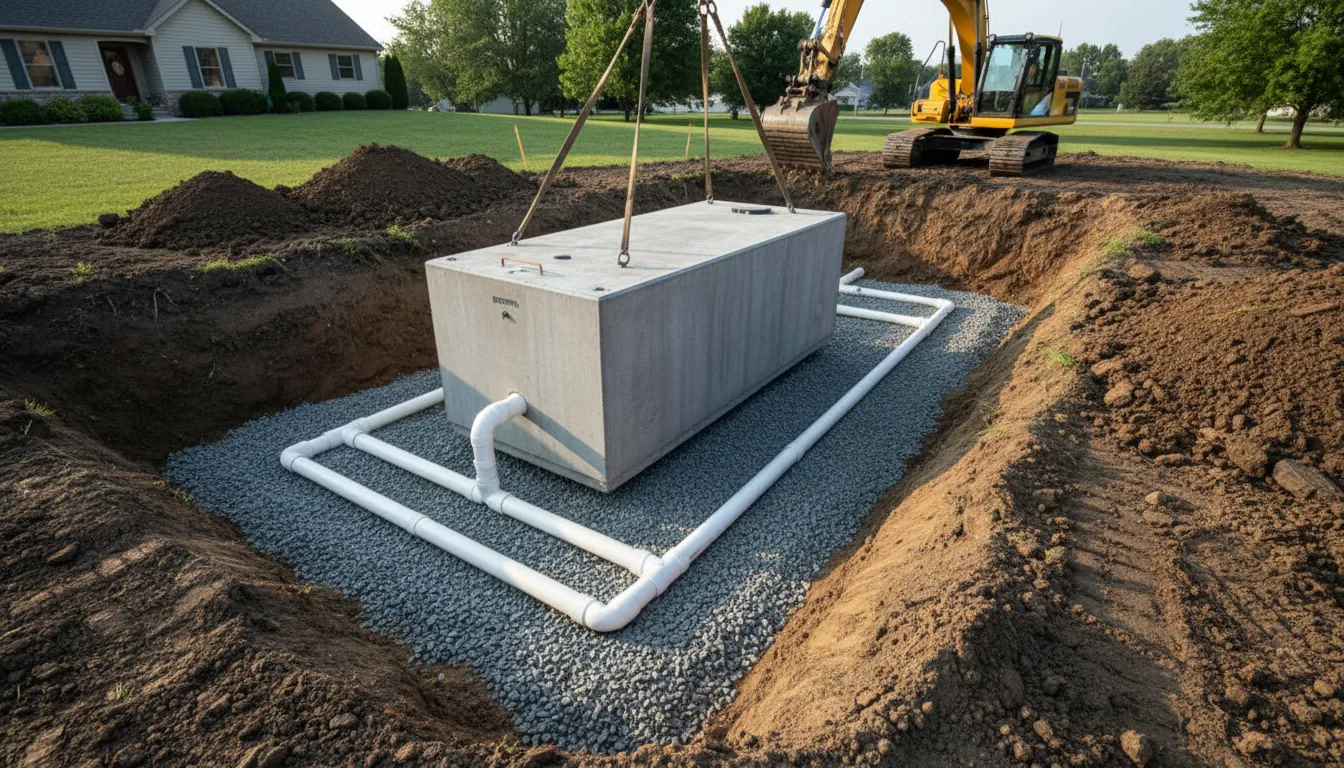
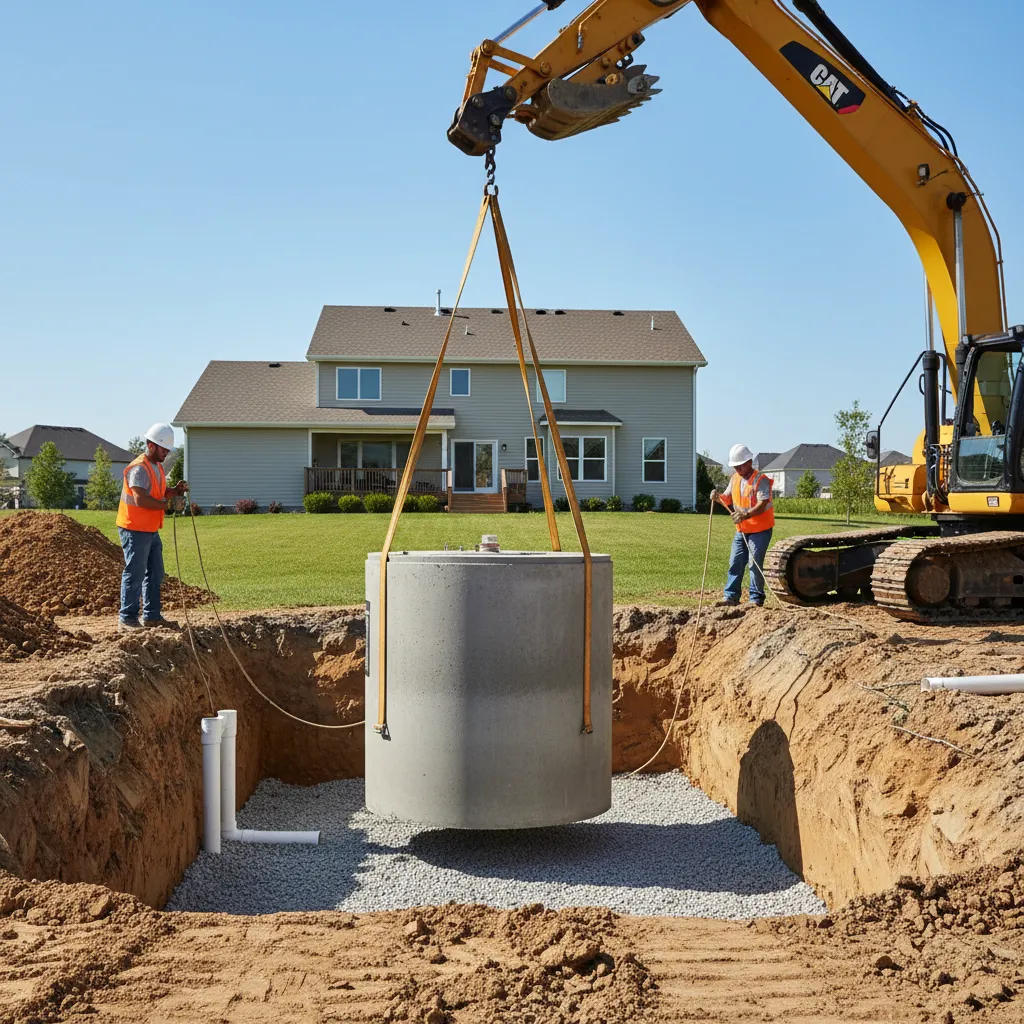
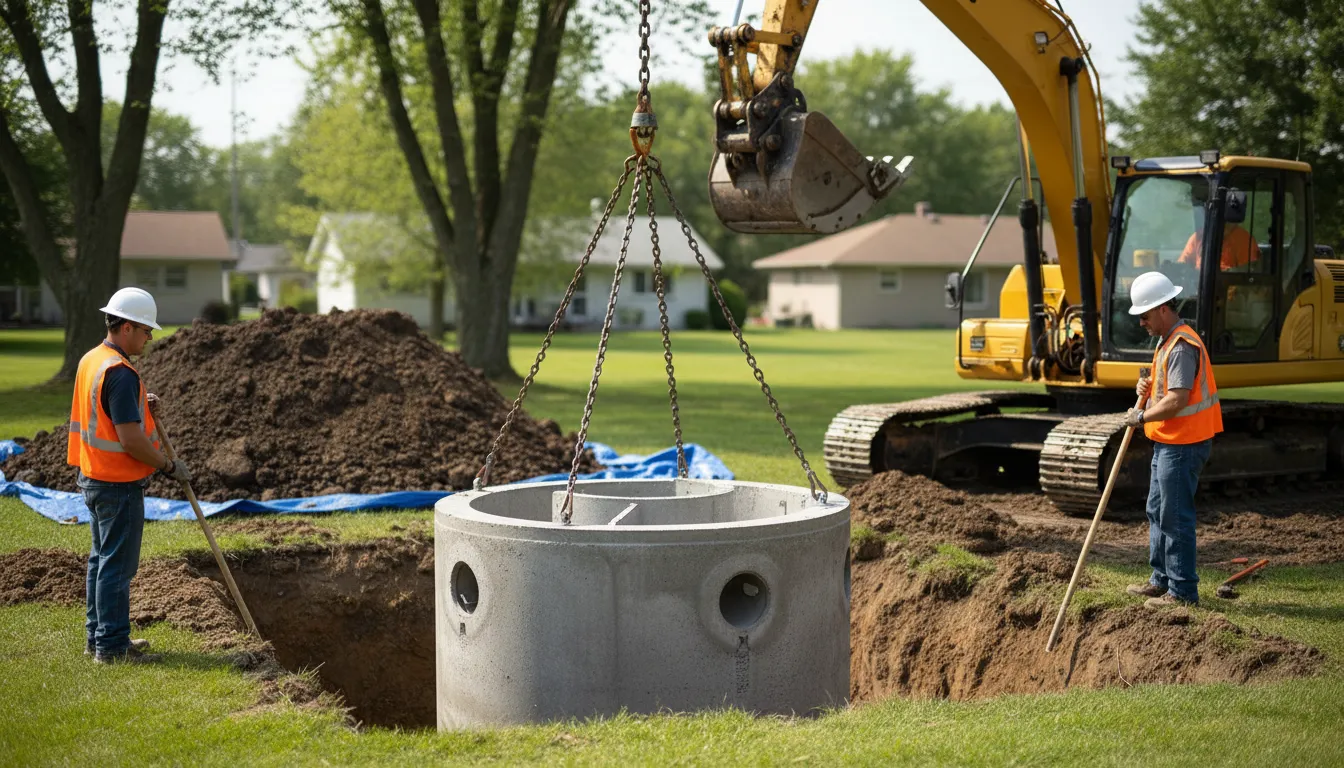
Our excavator and mini excavator operators excavate the tank hole, trench the lateral lines, and grade the pipe runs to maintain correct gravitational flow. We place the precast concrete or polyethylene septic tank on compacted stone aggregate, level it, and verify the inlet and outlet elevations. Special care is taken to ensure proper bedding.
Distribution and Drain Field Construction
We install the distribution box, connect perforated pipe laterals, and surround them with crushed stone wrapped in geotextile filter fabric. Each drain field trench receives the specified aggregate depth above and below the pipe. Our crew takes care in handling all components to avoid damage during placement.
Connection, Backfill, and Final Inspection
We connect the building sewer line to the septic tank inlet tee, install risers and access lids for easy future maintenance, and backfill all trenches with approved material. After compaction and final grading, the health department inspector certifies the completed system. We deliver your as built drawings and maintenance schedule. Your lawn and grass will be restored to an attractive condition once work is done.
Brands We Use
Action Septic Service installs components from trusted, top rated manufacturers known for durability in subsurface wastewater applications. For our conventional septic system installations, we rely on these ten brands:






Your conventional septic system deserves materials that perform reliably for decades underground.
Other Services
Conventional septic system installation
Gravity fed septic system install
Septic tank and drain field setup
Septic tank installation
Precast concrete septic tank placement
Underground wastewater tank install
Drain field installation
Leach field construction
Absorption trench excavation
Residential septic system install
On lot septic system installation
New home septic design and permit
septic system installer near me
Certified septic contractor
Licensed septic installation company
FAQs About Conventional Septic System Installation
What is a conventional septic system?
A conventional septic system is a two part, gravity fed wastewater treatment setup. A buried septic tank separates solids from liquids and allows anaerobic bacteria to partially digest organic sludge. Clarified effluent then flows by gravity through a distribution box into a network of perforated pipe laterals laid in gravel filled trenches. The surrounding soil filters and treats the remaining wastewater through natural biological and absorptive processes before it reaches groundwater. These systems work best in soils with the right absorption rate. From our view, they are the most reliable and clean option for onsite wastewater treatment.
When should I install a new conventional septic system?
You need a new installation when building on a lot without sewer access, replacing a failed or noncompliant system, decommissioning an old cesspool or old redwood tank requiring demolition, or converting from a holding tank. A perc test confirming adequate soil permeability is the first qualifying step. Please note that setback distance from your well is also required before we can move forward with your request.
How long does the installation process take?
Most residential conventional septic system installations take three to five working days once permits are approved. The typical timeline depends on site complexity. Permitting itself can take two to six weeks depending on your local health department’s review schedule and soil testing requirements. We work fast while maintaining quality on every installation.
Can I choose where the septic tank and drain field go on my property?
Location depends on required setbacks from wells, property lines, buildings, waterways, and easements. Your soil scientist and our design team select the best position based on soil conditions, slope, and regulatory distances. You’ll review and approve the site plan before we excavate.
Does a conventional system work on every property?
No. Properties with high water tables, shallow bedrock, heavy clay soils, or steep grades may not pass a percolation test for conventional design. Each site presents unique conditions. In those cases, alternative systems like mound systems, sand filters, or aerobic treatment units may be required. We also assist with installations serving modular homes, agricultural operations, dairy plants, and fast food restaurants. We assess your site and recommend the right solution.
How much does conventional septic system installation cost?
Costs vary based on tank size, drain field length, soil conditions, and local permit fees. Most residential installations range from $5,000 to $15,000, which is competitive with the market. Action Septic Service provides a detailed, fixed price quote after completing the site evaluation and perc test so you know the full cost before work begins. If you are wondering about pricing or have more questions, please give us a call by phone for free information. Ask us anything – we are happy to answer and will not be satisfied until you are. Once the job is done, you will see much more value in a personalized installation.
Ready to Schedule Your Conventional Septic System Installation?
Call now for fast, professional service – available 24/7 across all 50 states.